
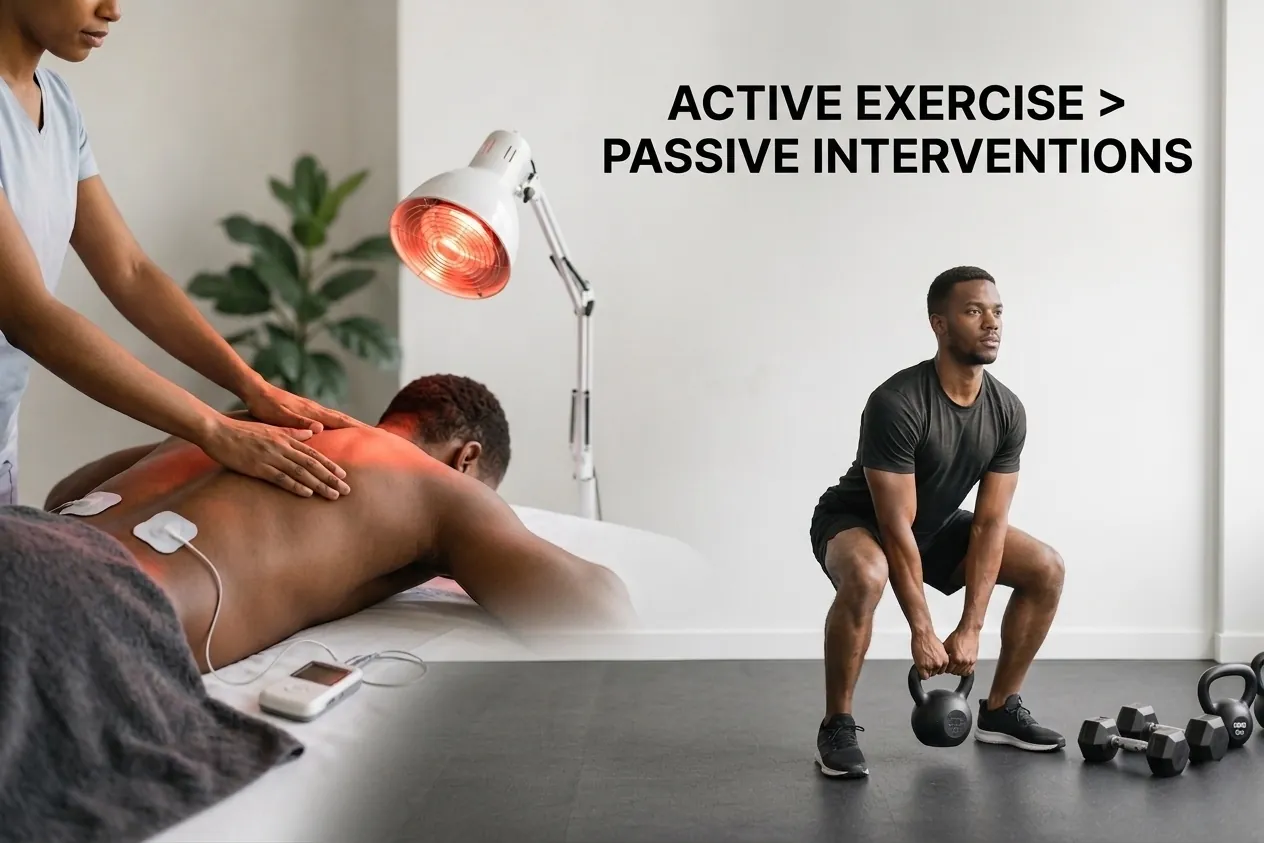

Massage feels good. Heat brings relief. Spinal adjustments can feel like a quick release. If you've lived with chronic back pain, you've likely tried at least one of these passive treatments—and felt better afterward, at least for a few hours or days.
Then the pain comes back.
This cycle isn't a coincidence, and it isn't your fault. It is the natural limitation of passive treatment: interventions that are done to you rather than performed by you.
What the Research Actually Shows
When researchers analyze decades of clinical trials comparing different back pain treatments, a clear pattern emerges. A landmark Cochrane systematic review analyzing over 249 randomized controlled trials confirmed that active exercise therapy is consistently superior to passive modalities for reducing pain and improving function in chronic low back pain.
A 2025 network meta-analysis published in the British Journal of Sports Medicine evaluated 117 treatment protocols across thousands of patients. The findings were decisive: high-dose passive treatments (like ultrasound, TENS, or passive stretching alone) showed minimal long-term benefit compared to placebo, while progressive movement protocols yielded lasting structural and neurological recovery.
"Passive treatments change how your brain feels your back for a few hours. Active movement changes how your back handles force for years."
Why Passive Treatment Feels Like the Answer
When a massage therapist works on a tight lower back or a heat pack is applied, several immediate physiological events occur:
- Sensory gating: Touch and warmth stimulate large-diameter nerve fibers that temporarily block pain signals from reaching your brain (the Gate Control Theory of Pain).
- Local blood flow: Heat increases cutaneous microcirculation, temporarily softening muscle tension.
- Endorphin release: Pleasant physical contact triggers a temporary release of natural pain-inhibiting neurochemicals.
These mechanisms are real and valuable—but they are temporary. They do not alter muscle endurance ratios, restore motor control, or retrain an over-protective central nervous system.
What Passive Treatment Is Actually Good For
Does this mean massage, heat, or manual therapy are useless? Absolutely not.
The clinical key is understanding their proper role: passive treatments are an on-ramp, not the destination. They create a temporary "window of desensitization"—a 2-to-4 hour period where pain volume is turned down.
If you use that desensitized window to sit on the couch, the effect fades and pain returns. But if you use that window to run your pattern-matched movement protocol, your brain learns that movement in that range is safe.
What a Properly Structured Recovery Looks Like
- Calm: Use brief symptom-calming positions or desensitization to lower immediate threat.
- Pattern Match: Identify your movement preference (flexion, extension, or nerve gliding).
- Rebuild: Gradually load core endurance ratios (flexor, extensor, side endurance).
- Perform: Return to full, confident movement without fear.
The Bottom Line
You don't need to be fixed on a treatment table. You need a system that reads your pain state and guides you through the right movement steps today.
Written by Alao Daniel
Licensed Physiotherapist
Physiotherapist specializing in musculoskeletal rehabilitation, pain neurobiology, and evidence-based chronic back pain recovery.
Find out what is actually going on
A few short questions, about five minutes. They check that it is safe to treat you before anything is booked.
Start understanding your pain