
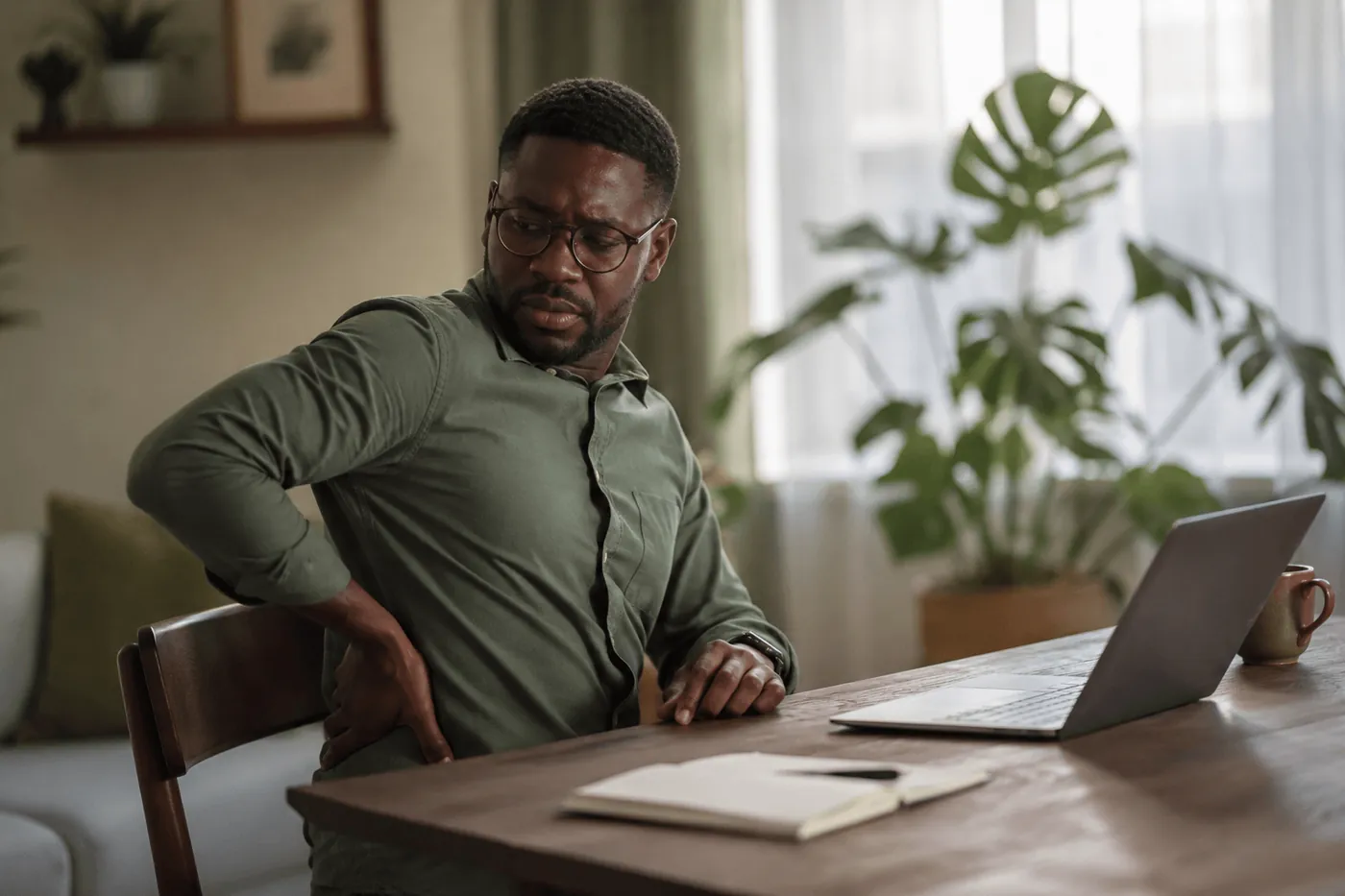

You've probably heard the phrase "sitting is the new smoking." It's catchy, alarming—and clinically incorrect.
Sitting does not destroy your intervertebral discs. It does not permanently misalign your pelvis. And it is not inherently dangerous to your spine.
So why does sitting for 30 minutes leave so many people with severe, dull aching or stiffness when they try to stand up?
Sitting is a Position, Not an Injury
The human spine is designed to sit, bend, twist, and load. Biomechanical studies measuring intra-discal pressure show that sitting slightly increases disc pressure compared to standing, but well within the spine's safe structural tolerance.
The issue isn't sitting itself. Pain from sitting usually comes down to two factors:
- Postural fatigue: Holding any single static position for long periods restricts local capillary circulation and causes muscle fatigue.
- Directional sensitivity: Sitting puts your lumbar spine into flexion (a slight forward curve). If your back pain pattern happens to be flexion-sensitive, sitting aggravates it.
The Clue Hiding Inside Your Sitting Pain
Instead of fearing sitting, treat your sitting pain as valuable diagnostic data:
- If sitting hurts, but walking or standing feels better → You likely have a flexion-biased pattern. Your spine needs extension movement to rebalance.
- If standing hurts, but sitting brings immediate relief → You likely have an extension-biased pattern. Your spine needs flexed unloading routines.
Three Rules for Sitting Without Back Pain
- Change positions every 30–45 minutes: The best posture is your next posture. Micro-breaks restore blood flow.
- Perform your directional counter-movement: If you sit flexed for an hour, stand up and perform 5 gentle lumbar extensions (standing back bends).
- Stop guarding: Stiffening your torso tightly while sitting increases compressive load. Relax your breath and lean back into support.
Written by Alao Daniel
Licensed Physiotherapist
Physiotherapist specializing in musculoskeletal rehabilitation, pain neurobiology, and evidence-based chronic back pain recovery.
Find out what is actually going on
A few short questions, about five minutes. They check that it is safe to treat you before anything is booked.
Start understanding your pain